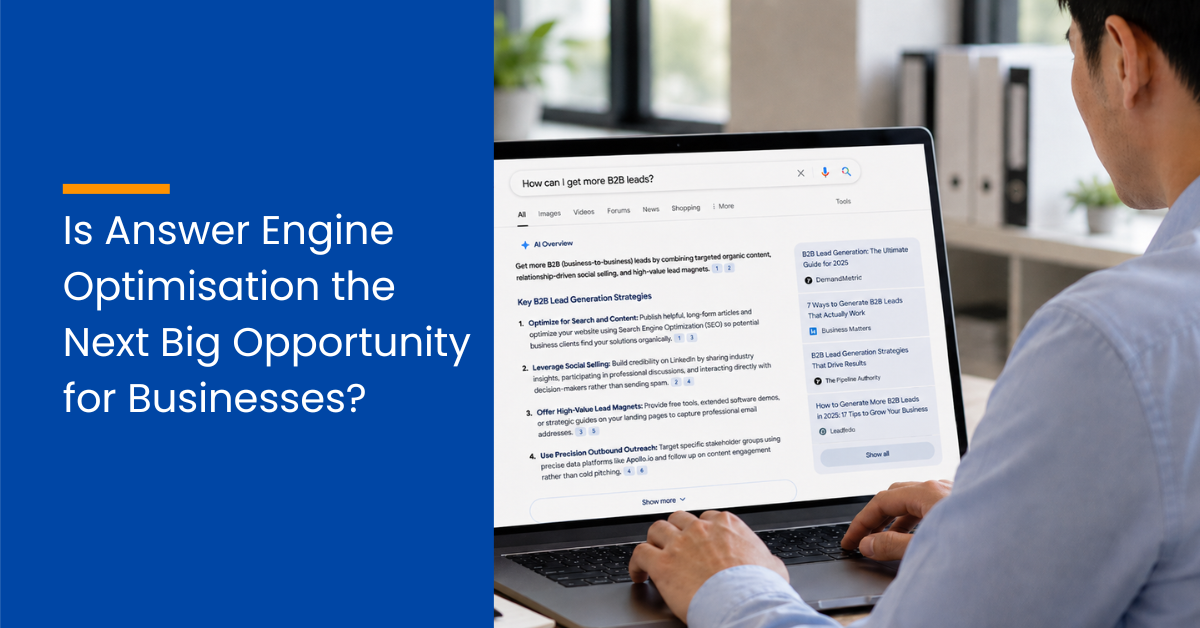
 A prospect calls. They already know your service range, they've got a rough idea of your pricing, and they mention two competitors by name, including one you consider a stretch to be compared against.
You ask how they found you. They say they asked ChatGPT.
You have no record of the visit. Nothing in your analytics. No form fill, no gated download, no ad click. The entire research phase happened somewhere you cannot see, and by the time the conversation reached you, the shortlist was already built.
Now the harder question. How many prospects went through that same process this quarter and never called, because you weren't one of the names that came back?
That is the question Answer Engine Optimisation (AEO) is actually about. And what we found in our own accounts suggests the answer is uncomfortable.
Key Takeaways
- Why Buyer Intent Is Becoming Harder to See Through Traditional Search Data
- How AI-Assisted Search Is Changing the Way Buyers Discover and Shortlist Businesses
- Where AEO Fits Within the Bigger Picture of SEO and Digital Visibility
- Why Strong Content Alone Is Not Enough to Build Visibility in AI Search
- Four AEO Tactics That Could Distract Marketers From What Actually Matters
- What to Prioritise to Strengthen Visibility in AI Answers
- How to Assess Your Business's Current AI Search Visibility in 10 Minutes
- Frequently Asked Questions About AEO and AI Search Visibility
Why Buyer Intent Is Becoming Harder to See Through Traditional Search Data
On a B2B technology account we manage, we built out the phrases a real buyer would type: "AI hardware consultant Malaysia", "workstation for data science Malaysia." Google flagged them as low search volume, under ten searches a month, and made them inactive. They would not even serve.
That reads as "no demand." It isn't. Low search volume does not necessarily mean the underlying buyer need has disappeared. Some of those questions may now be happening conversationally through AI tools, where traditional keyword reporting gives marketers far less visibility.
Across the clients we manage in education and B2B technology, we see the same pattern: branded search converts more efficiently than category discovery. On one education account over a twelve-month period, non-branded keywords absorbed roughly 60% of search budget while producing about half the leads, at a cost per lead a third higher than branded terms. The pattern holds across the other accounts we reviewed.
These are strong, well-known brands. They convert efficiently when someone already knows their name, and go expensive or absent when someone asks a category question.
That gap, between "find me by name" and "tell me who is good at this," is what AEO actually describes. Not a new channel. A visibility gap that has always existed and has suddenly started to cost money.
How AI-Assisted Search Is Changing the Way Buyers Discover and Shortlist Businesses
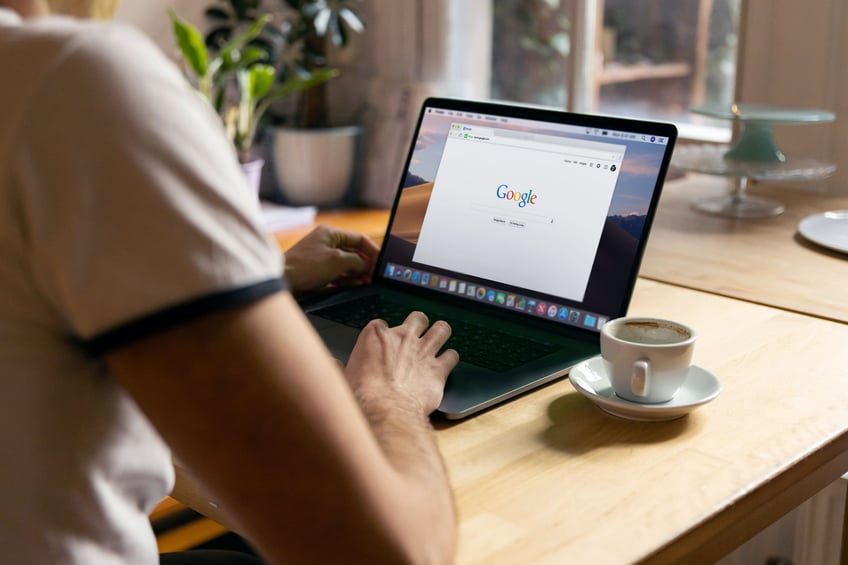
The old journey:
Search → browse → visit sites → compare → shortlist.
The buyer did the synthesising, and everyone in the results got a shot.
The new one:
Ask → receive one synthesised answer → explore what was recommended
The buyer inherits a shortlist someone else assembled.
It shows up in three places.
- Discovery. "Who are the leading B2B lead generation agencies in Malaysia?" Four names come back. The rest weren't rejected, they were never in the room.
- Comparison. "Compare these agencies on B2B experience and approach." The comparison table your sales deck used to control is now built by something else, from whatever it can find about you.
- Validation. "What do customers say about this company?" Your website becomes one input among many. Reviews, partner websites, listings and other third-party sources can add context beyond what your brand says about itself.
Education looks identical. Students and parents compare programmes, fees and outcomes weeks before any campus site gets a visit. In our own AEO planning for an education client, the questions that mattered most weren't branded at all: "What are the best private colleges in Malaysia after SPM?" Those moments happen entirely outside the brand's own properties.

Where Answer Engine Optimisation (AEO) Fits Within the Bigger Picture of SEO and Digital Visibility
Answer Engine Optimisation is the practice of making your business understandable, verifiable and citable inside AI-generated answers. SEO ranks your page in a list. AEO gets your brand named in the answer.
|
Traditional SEO |
AI search / AEO |
|
|
Goal |
Rank in a list |
Be named in the answer |
|
Wins on |
Keywords, backlinks, technical health |
Clarity, structure, corroboration |
|
Buyer sees |
Your page, in your words |
Your brand, described second-hand |
|
Outcome |
A visit |
A mention, a citation, or nothing |
Note what the buyer actually sees. Your brand is described by something other than your marketing team, using sources you did not write.
This is not an "SEO is dead" argument. Answer engines still rely on relevance, quality and crawlability. Search visibility is expanding, not being replaced.
%20Fits%20Within%20the%20Bigger%20Picture%20of%20SEO%20and%20Digital%20Visibility.jpg?width=848&height=636&name=Where%20Answer%20Engine%20Optimisation%20(AEO)%20Fits%20Within%20the%20Bigger%20Picture%20of%20SEO%20and%20Digital%20Visibility.jpg)
Why Strong Content Alone Is Not Enough to Build Visibility in AI Search
The standard prescription is more content: FAQs, clearer headings, more pages. All fine. All insufficient alone.
An answer engine's constraint isn't finding information about you. It's deciding whether that information is trustworthy enough to state as fact. Content is part of the answer, but it works alongside business clarity, consistency and wider digital credibility.
- Your details don't match. Name, address, phone and service description differ across your website, Google Business Profile, LinkedIn and old directories. Every inconsistency is a reason to hedge or omit you.
- Nobody independent has mentioned you. Your website is a claim; reviews, listings, coverage and partner pages are evidence. Strong content with no corroboration is an unsupported assertion, exactly what these systems are built to be careful about.
- Your positioning is vague. If your homepage says "we empower transformational growth" rather than "we're a B2B lead generation agency in Kuala Lumpur," you haven't given anyone a category to file you under. You can't be recommended for a question you aren't associated with.
Which reorders the usual advice: before commissioning a content programme, check whether your business is corroborable at all.
Four Answer Engine Optimisation (AEO) Tactics That Could Distract Marketers From What Actually Matters
- Treating AEO as an SEO replacement. You still need crawlable pages and sound foundations. AEO is not permission to skip the basics.
- Publishing volume. Three hundred thin pages for three hundred question variants. Thin pages do not get cited. They get crawled.
- Hunting for a shortcut. Hidden instructions, special files, formatting tricks. This is 2011 SEO in new packaging and it will age the same way.
- A strategy per platform. The signals overlap heavily and the ground moves faster than any platform-specific plan can keep up with. AirOps' 2026 State of AI Search reported that only 30% of brands stay visible from one answer to the next, and BrightEdge found citation churn varies sharply by sector, from 51% of finance domains seeing changes week to week down to under 4% of government sites. Chasing each platform separately means rebuilding the same work every quarter. Fix clarity and corroboration once.
%20Tactics%20That%20Could%20Distract%20Marketers%20From%20What%20Actually%20Matters.jpg?width=848&height=565&name=Four%20Answer%20Engine%20Optimisation%20(AEO)%20Tactics%20That%20Could%20Distract%20Marketers%20From%20What%20Actually%20Matters.jpg)
What to Prioritise to Strengthen Visibility in AI Answers
1. Fix verifiability first
Consistent details everywhere, claimed profiles, plain category language. Unglamorous, largely one-off, and the floor everything else stands on.
2. Earn corroboration
Mentions, reviews, listings, partner sites, real customer stories. Slow, compounding, hardest to shortcut, which is why it works. A Muck Rack analysis of over 25 million cited links across ChatGPT, Claude and Gemini found earned media made up 84% of AI citations, against 0.3% for paid and advertorial content. You cannot buy your way into this.
3. Then write for buyer questions
Not topics. Questions. A Finance Director asks about the payback period. An Operations Director asks how disruptive implementation will be. A parent asks what their child can progress into. Ten articles for a generic "target audience" answer none of them.
This is where buyer persona work stops being a nice-to-have. A useful persona isn't age and job title, it's needs, objections and decision context, which is what tells you which questions to answer.
On one education account, rewriting ad messaging around persona interview findings lifted enquiries by more than 60% and moved conversion rate from around 8% to over 12%. Better questions answered.
4. Make each answer self-contained
Compare "many businesses face numerous digital marketing challenges in a competitive landscape" with "if your cost per lead rose this month, don't change budget, targeting and creative at once, check demand, competition, search terms and landing-page conversion separately."
The second is usable in one sentence. Better for humans, and clearer for a machine to quote.
How to Assess Your Business's Current AI Search Visibility in 10 Minutes
You can start with a simple visibility check. The goal is not to create a scientific score, but to see how your business appears when buyers ask the kinds of questions that matter.
- Ask an AI tool: "Who are the leading [your category] providers in [your market]?" Note who appears.
- Ask: "Tell me about [your company]." Is the information accurate and current?
- Compare your name, service description, location and contact details across your website, Google Business Profile and LinkedIn.
- Search your company name excluding your own domain. What independent sources appear?
- Read your homepage headline aloud. Does it clearly state what your business does?
- List five questions your sales team hears constantly. Are the answers already on your site?
Treat the result as directional rather than a score. AI answers vary by platform, prompt and time, but the exercise can still reveal whether your bigger gap is clarity, credibility or content.

Is Answer Engine Optimisation (AEO) Really the Next Major Digital Marketing Opportunity for Businesses?
Yes, but not the one being sold.
EO may be presented as an entirely new marketing discipline. We think that overstates the change. Most of the work underneath it already sits within SEO, content, buyer research, brand credibility and good digital fundamentals.
What has changed is that AI answers turned basic business hygiene into a visibility mechanism: consistent information, independent credibility, clear positioning. Boring work now compounds, which it previously did not.
Good news for businesses doing the fundamentals. More challenging for businesses accustomed to relying heavily on paid visibility, because organic inclusion in an AI-generated recommendation is not something a brand can simply buy.
The businesses best positioned to benefit will not be the ones producing the most AEO content. They will be the ones that are easy to understand, credible beyond their own website, and genuinely useful when buyers have questions.
So the useful question is not "should we invest in AEO?" It is whether your business is verifiable enough, and your content close enough to real buyer questions, for an AI to recommend you with confidence. For most companies the answer is not yet, and the gap is rarely where they expect it to be.
Start with the ten-minute check above. If your own name returns something you would not have written, you have found your first priority.
Does your content reflect how your buyers search, research and make decisions today?
clickTRUE helps businesses understand their buyers and turn those insights into more relevant content through Buyer Persona Development, Content Creation and Inbound Marketing.
Talk to clickTRUE about aligning your content with today's buyer journey.
_________________________________________________________________________
Frequently Asked Questions About Answer Engine Optimisation (AEO) and AI Search Visibility
1. What does AEO stand for?
Answer Engine Optimisation. It means making a brand, website or piece of content easy to understand, verify and cite inside answer-driven search experiences such as ChatGPT, Gemini, Perplexity and Google AI Overviews.
2. Is AEO the same as SEO?
They overlap heavily. SEO targets visibility in a ranked list; AEO targets being named or cited within a generated answer. Strong SEO foundations remain directly relevant, so treat AEO as an extension of good search practice rather than a replacement.
3. Do businesses need a separate AEO budget?
Usually not. Start with work already sitting inside SEO, content marketing, brand management and buyer research. A separate investment may make sense later where there is a clear measurement need, but a new acronym does not require a new programme.
4. How can I check whether my business appears in AI answers?
Ask the questions your buyers would genuinely ask: category and comparison questions, not just your company name. Check whether you appear, how you are described, and which sources are cited. Treat the result as directional, because responses vary by platform, prompt and week.
5. Should I create more content for AEO?
Only if it answers a real buyer question. Identify the questions, objections and comparisons that matter during the decision, and answer those properly. Clarity beats volume.
6. Why does my business rank well but still not appear in AI answers?
Ranking and corroboration are different problems. Ranking rewards your page; being cited rewards evidence about you from sources other than your page. If your details are inconsistent, or nothing independent has mentioned you recently, an answer engine has little reason to state anything about you as fact.
 hello@clicktrue.biz
 info.my@clicktrue.biz
 info.th@clicktrue.biz
 info.id@clicktrue.biz
 info.vn@clicktrue.biz